In this article
If you have ever opened an Arabic textbook and then listened to people talking in the street in Cairo, you probably noticed they do not sound the same. That is not your imagination. Arabic has a formal standard that is used in writing, news and speeches, and a family of spoken dialects that people use at home, at work and with friends. For most learners the first big decision is simple: do I start with Modern Standard Arabic (MSA) or with Egyptian Arabic?
This guide gives you a clear answer based on your goal, with real examples so you can hear the difference for yourself.
What is Modern Standard Arabic (MSA)?
Modern Standard Arabic, called fuṣḥā (فصحى) by Arabs, is the formal version of the language. It is used in books, newspapers, official documents, television news, speeches and university teaching across the Arab world. It is also closely related to the Arabic of the Quran, which is why many learners choose it for religious study.
Almost nobody speaks MSA as a mother tongue. Children grow up speaking a dialect at home and meet MSA at school. In everyday life, MSA is mostly used when people from different countries need a shared formal language.
What is Egyptian Arabic?
Egyptian Arabic, called Maṣri or ʿāmmiyya (عامّيّة), is the everyday spoken language of Egypt. Roughly 100 million people speak it, and it is the language of Egyptian family life, markets, offices, humor, songs and social media.
It is a complete language with its own vocabulary, grammar patterns and pronunciation, not a “broken” version of MSA. Egyptians write it in Arabic letters in messages and online, but it is rarely used in formal writing.
Side-by-side: the same ideas in both
The quickest way to feel the difference is to compare common words.
| Meaning | Modern Standard Arabic | Egyptian Arabic |
|---|---|---|
| What? | ماذا (mādhā) | إيه (eh) |
| Now | الآن (al-ān) | دلوقتي (delwaʾti) |
| I want (m.) | أريد (urīdu) | عايز (ʿāyez) |
| How are you? (to a man) | كيف حالك؟ (kayfa ḥāluk) | إزيك؟ (ezzayyak) |
| Where? | أين (ayna) | فين (feen) |
| Why? | لماذا (limādhā) | ليه (leih) |
| Very | جدًّا (jiddan) | أوي (awi) |
| Good / fine | جيّد (jayyid) | كويس (kwayyes) |
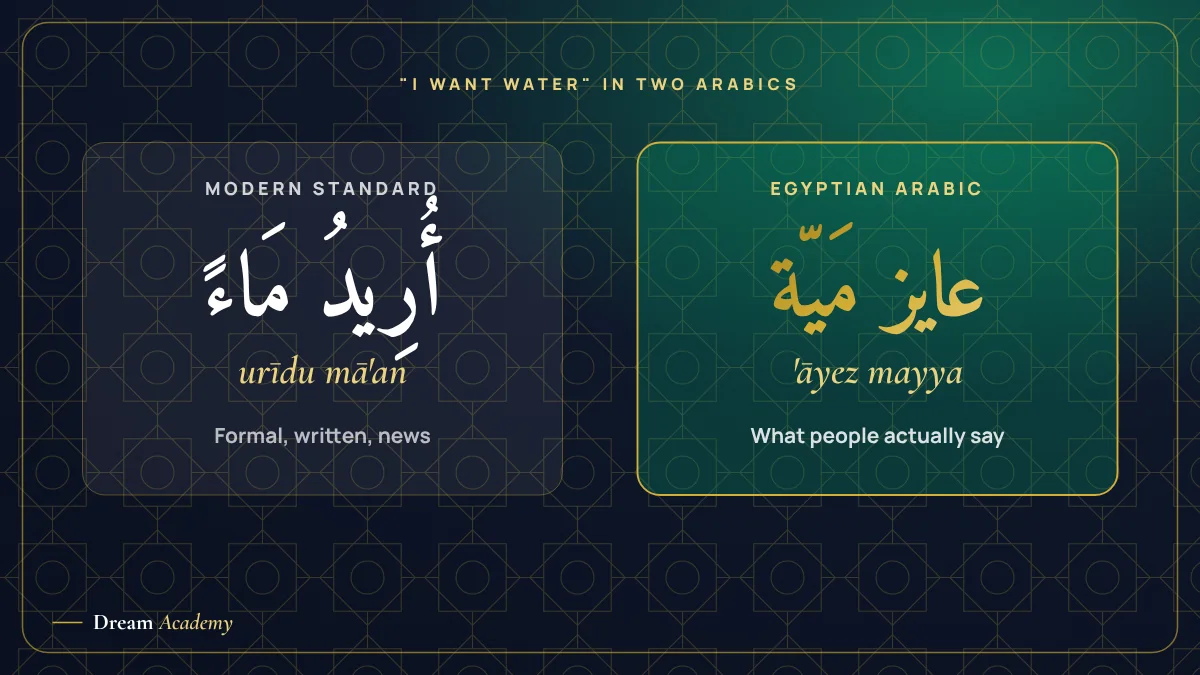
If you walk into a café in Cairo and say “أريد ماءً” in perfect MSA, people will understand you, but it will sound like a news bulletin. Saying “عايز مَيّة” is what people actually say.
Why many learners start with Egyptian Arabic
- You can use it immediately. Greetings, taxis, shopping, restaurants and small talk all happen in dialect.
- It makes conversation feel natural. You learn the rhythm and expressions that people really use, so you sound like a person rather than a textbook.
- Egyptian media is everywhere. Films, drama series, comedy, music and YouTube give you endless listening practice. Read more in why Egyptian Arabic is the most widely understood dialect.
- It is motivating. Being able to chat with your neighbors, your colleagues or your in-laws after a few weeks keeps you going.
When MSA is the better first step
- You want to read. Books, newspapers, official forms and most websites use MSA.
- You are studying the Quran or Islamic texts. Quranic Arabic is Classical Arabic, and MSA gives you a strong base for it. Many students pair MSA with Quran recitation and Tajweed.
- You plan an academic or translation career. Universities and professional certificates are based on MSA.
- You will work with Arabs from many countries and need a formal shared language.
Can you learn both? The best order
Yes, and many people do. A path that works well:
- Start with Egyptian Arabic for speaking. Build listening and conversation confidence first.
- Learn the alphabet and basic reading in parallel. See our guide to learning the Arabic alphabet in 7 days.
- Add MSA once you can hold basic conversations, so reading and formal Arabic feel like an upgrade instead of a wall.
The two are related, so each one makes the other easier. Many words and most of the grammar are shared, and learning one does not mean losing the other.
Which should you choose? A quick guide
| If your main goal is… | Start with |
|---|---|
| Living, working or studying in Egypt | Egyptian Arabic |
| Speaking with Egyptian family or friends | Egyptian Arabic |
| Understanding Arabic films and series | Egyptian Arabic |
| Reading news, books and websites | MSA |
| Quran and Islamic studies | MSA together with Quran and Tajweed courses |
| Academic or professional certificates | MSA |
How to get started
The fastest way to learn is with a live tutor who can correct your pronunciation from day one and adapt the lessons to your goals. At Dream Academy you can start with Egyptian Arabic, add Modern Standard Arabic when you are ready, or combine them with Arabic conversation classes.
Frequently asked questions
Will people understand me if I only learn Egyptian Arabic?
Yes in Egypt, and often in other Arab countries too, because Egyptian films, series and songs are widely known across the region. You will still want to adapt to local words when you travel.
Will people understand me if I only learn MSA?
They will understand you, especially in formal settings, but it can sound very formal in daily conversation. Many people find MSA harder to speak spontaneously.
Is Egyptian Arabic easier than MSA?
For speaking, many learners find Egyptian Arabic easier to start with because it is simpler in some grammar details and it is the language you hear around you. MSA has more complex grammar and endings, but it follows consistent rules.
Do I need to learn the Arabic script for Egyptian Arabic?
You can start speaking with transliteration, but learning the script early makes your pronunciation more accurate and opens the door to reading later.
Ready to try it? Book a free trial class and your tutor will help you choose the best starting point for your goals.
Book Your Free Trial