In this article
- What the official estimate says
- Why Arabic takes longer for English speakers
- Realistic milestones for speaking Egyptian Arabic
- What those hours look like in real life
- Three example study plans
- What "progress" looks like in plain English
- What speeds you up
- What slows you down
- A practical way to plan
- Frequently asked questions
“How long will it take me to learn Arabic?” is the question every learner asks, and the honest answer is: it depends on what you mean by “learn” and which Arabic you choose. Speaking with confidence in daily situations takes much less time than reading a newspaper or reaching professional fluency.
This guide gives you realistic numbers, explains why Arabic has a reputation for being slow, and shows what you can do to make steady progress.
What the official estimate says
The U.S. Foreign Service Institute (FSI) groups languages by how long they take English speakers to learn. Languages such as Spanish and French sit in the easiest group, at roughly 600 to 750 class hours. Arabic is in the hardest group, with an estimate of about 2,200 class hours, which is around 88 weeks of full-time study to reach professional working proficiency.
Two things to keep in mind:
- This estimate is for professional working proficiency, including reading, writing and formal Arabic, which is a very high target.
- It mostly reflects Modern Standard Arabic. Learning a spoken dialect such as Egyptian Arabic for conversation can get you communicating much earlier.
Why Arabic takes longer for English speakers
- A new script. Arabic is written right to left, and letters change shape depending on position.
- New sounds. Several throat sounds do not exist in English.
- Two layers of the language. The formal standard and the spoken dialects differ, so learners often study both over time.
- Different vocabulary roots. There are few familiar-looking words, unlike learning a European language.
None of this makes Arabic impossible. It simply means you need a plan and patience.
Realistic milestones for speaking Egyptian Arabic
These are rough planning ranges, not guarantees. Your results depend on your starting point, your consistency and how much you speak and listen outside class.
| Class hours (cumulative) | What you can usually do |
|---|---|
| 40 to 80 hours | Greet people, introduce yourself, handle simple shopping, taxis and restaurants |
| 150 to 250 hours | Hold basic conversations about daily life, work and family, and follow slow, clear speech |
| 400 hours and more | Discuss many everyday topics, understand most casual speech, and tell stories with some mistakes |
Reading and writing add time on top, depending on how deeply you want to go.
What those hours look like in real life
Hours of class do not mean much until you turn them into a calendar. Here is the arithmetic for one-hour classes:
| Classes per week | Hours per year | Time to reach about 150 hours |
|---|---|---|
| 2 | about 100 | about 18 months |
| 3 | about 150 | about 12 months |
| 4 | about 200 | about 9 months |
| 5 | about 250 | about 7 months |
Add your own daily practice (listening, flashcards, speaking with friends) and you will move faster than the class hours alone suggest. Dream Academy packages are built around 2 to 5 classes per week, so you can choose the pace that matches your goal and schedule.
Three example study plans
The busy professional (2 classes a week). Two live classes plus 15 minutes of daily review gives you about 100 class hours in a year. This is a comfortable pace for steady progress, and you can speed it up by adding short daily listening.
The expat preparing to move (4 classes a week). Four classes a week plus daily listening builds survival and everyday Arabic in a few months. Add real conversations with neighbors and shopkeepers and you get extra practice every day.
The serious learner (5 classes a week). About 250 class hours a year, plus homework and listening, is the fastest path to real conversational confidence. Rest days still matter, so plan them.
What “progress” looks like in plain English
Instead of counting only hours, check what you can actually do:
- Month 1: introduce yourself, greet people and ask simple questions.
- Month 3: order food, ask for directions and talk about your day in short sentences.
- Month 6: hold a basic conversation about family, work and plans, even if you make mistakes.
- Month 12: discuss many everyday topics, follow slow, clear speech in series and tell short stories.
Your timeline will differ, and that is fine. The point is to measure what you can do, not only how long you have studied.
What speeds you up
- Choose your goal and your Arabic. If your goal is speaking, start with Egyptian Arabic instead of beginning with formal grammar.
- Learn with a live tutor. Instant correction of pronunciation and sentences prevents bad habits.
- Practice daily, even for 15 minutes. Short and frequent beats long and rare.
- Listen a lot. Egyptian series, comedy and music give you free practice. Our beginner roadmap shows how.
- Learn the alphabet early. You can learn the Arabic letters in 7 days, and it improves everything else.
- Speak from the first month. Real conversation turns knowledge into skill.
- Review and track progress. Record yourself monthly to see how far you have come.
What slows you down
- Switching resources every few weeks.
- Studying only on weekends.
- Avoiding speaking until you feel ready.
- Relying only on apps without a human speaking partner.
- Aiming for perfection instead of communication.
A practical way to plan
- Write your goal: for example “hold a 10-minute conversation with my in-laws in 6 months”.
- Pick a weekly schedule you can keep for at least a year (for example 3 classes a week).
- Add daily micro-practice: 15 to 30 minutes of listening or review.
- Check in every month and adjust.
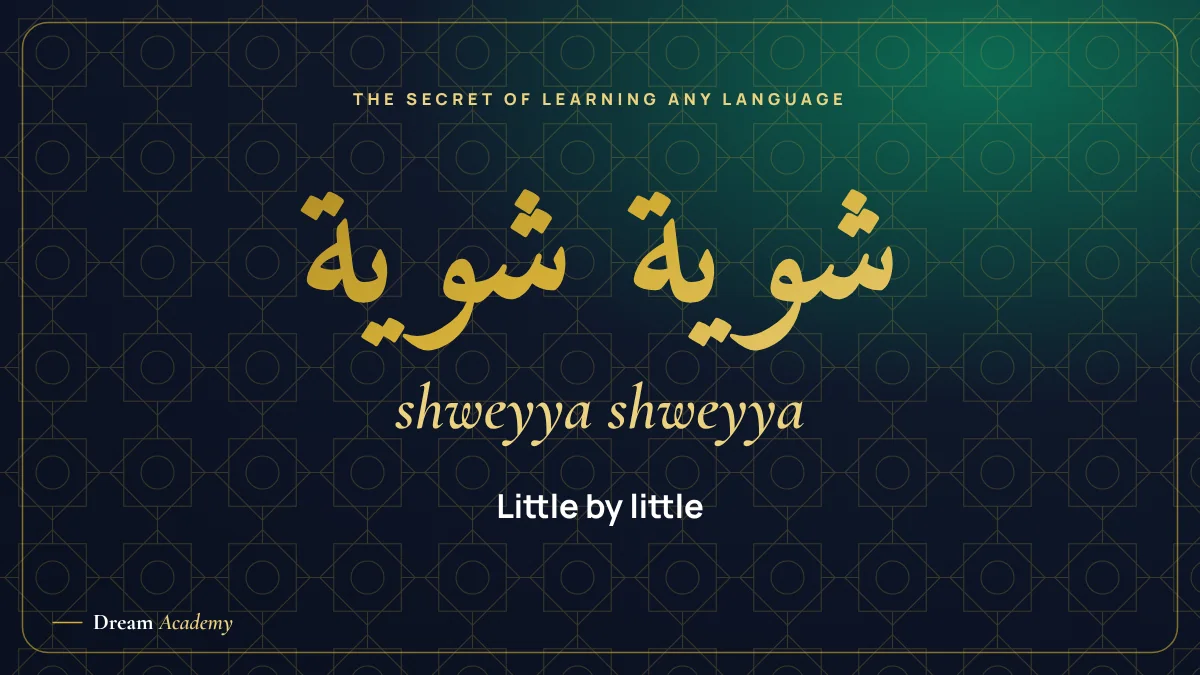
Remember the Egyptian saying shweyya shweyya (شوية شوية), “little by little”. Steady practice wins.
Frequently asked questions
Can I learn Arabic in 6 months?
You can reach a useful survival and basic conversation level in six months with regular lessons and daily practice, especially in a spoken dialect. Professional fluency takes longer.
Is Egyptian Arabic faster to learn than Modern Standard Arabic?
For speaking, many learners find they can start communicating sooner with a spoken dialect because it is the language people actually use in daily life. Reading formal texts requires MSA.
How many hours a day should I study?
Consistency matters more than long sessions. Many adults do well with a few live classes per week plus 20 to 40 minutes of daily practice.
Do I need to live in an Arabic-speaking country to learn?
No. Online lessons with a live tutor, plus daily listening, give you strong progress from anywhere.
Ready to plan your own timeline? Book a free trial class and your tutor will map out a realistic path for your goal.
Book Your Free Trial