In this article
- A word of encouragement first
- Step 1: Start with the right mindset
- Step 2: Learn the Arabic letters and sounds
- Step 3: Learn how the letters join and the short vowels
- Step 4: Begin with short surahs
- Step 5: Add Tajweed gradually
- Step 6: Learn with a teacher who can hear you
- Step 7: Build a daily routine
- Step 8: Track your progress and set realistic goals
- How long does it take?
- Common challenges and how to handle them
- Next steps
- Frequently asked questions
Many adults dream of reading the Quran for themselves but feel it is too late, too hard, or too embarrassing to start. If that is you, you are in very good company. Adults of every age, background and country begin learning to read the Quran every day, and with patience, a good teacher and a steady routine, it is very achievable.
This guide gives you a calm, step-by-step path.
A word of encouragement first
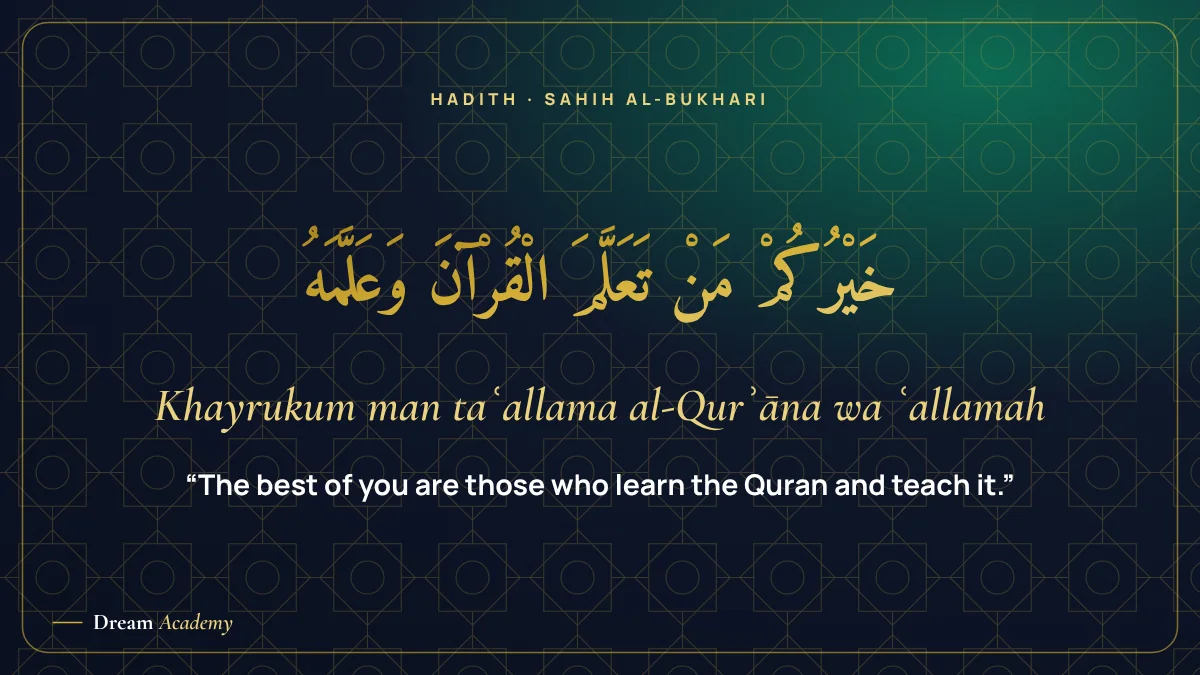
The Prophet ﷺ is reported to have said that the one who recites the Quran skillfully will be with the noble angels, and the one who recites with difficulty and struggles through it will have a double reward (reported in Sahih al-Bukhari and Sahih Muslim). In other words, the effort you put in matters, even when it is hard.
Step 1: Start with the right mindset
- You are not late. Learning something new as an adult is slower in some ways and faster in others, because you have focus and motivation.
- Mistakes are normal. Every reader began with stumbling.
- Progress is measured in small steps. One line read correctly is a win.
Step 2: Learn the Arabic letters and sounds
The Quran is written in Arabic, so the first goal is to recognize the letters and how they are pronounced. Many beginners start with the 28 letters, their shapes and sounds. See our guide to learning the Arabic alphabet in 7 days.
Pay special attention to the sounds that are new to English speakers: ع ح خ غ ق ص ض ط ظ. A teacher who hears you can correct these early, which prevents habits that are hard to undo later.
Step 3: Learn how the letters join and the short vowels
The Quran is fully marked with short vowels and signs, which makes reading possible even if you do not know Arabic. In this step you learn:
- how letters connect to form words,
- the short vowels (fatḥa, kasra, ḍamma) and the sukūn,
- long vowels (ا و ي),
- the shadda (doubled letter) and tanween (the ending “-un”, “-an”, “-in”).
Many teachers use a beginner reading primer, often called al-Qāʿidah al-Nūrāniyyah, to build these skills step by step.
Step 4: Begin with short surahs
Once you can read connected words, start with short surahs, which are usually at the end of the Quran. Begin with Al-Fātiḥah, which is recited in every prayer, and then move through the short surahs of Juz’ ʿAmma. These are short, familiar and perfect for building fluency and confidence.
Step 5: Add Tajweed gradually
Tajweed is the set of rules for pronouncing the Quran correctly, giving each letter its due. You do not have to learn everything at once. Introduce the rules one at a time, as you meet them in your reading: for example, the correct points of articulation, the elongation of vowels (madd), and the rules of the noon and meem. Our Tajweed rules for beginners guide gives you a clear overview, and the Tajweed course builds it step by step with a teacher.
Step 6: Learn with a teacher who can hear you
Quranic recitation has traditionally been learned by listening to a teacher and reciting back to them. This is because the correct sounds are passed down by hearing, not just by reading about them. A live teacher can:
- listen to your pronunciation and correct it right away,
- move you forward at a pace that suits you,
- explain Tajweed rules in a simple way,
- encourage you when you feel stuck.
Check our tips for choosing an online Arabic or Quran tutor. If you are looking for live guidance, our Quran recitation classes are one-on-one and designed for adult beginners.
Step 7: Build a daily routine
Short and consistent beats long and rare. A simple routine for busy adults:
- 2 to 4 live lessons per week with your teacher.
- 10 to 20 minutes of daily practice reading your assigned lines aloud.
- Daily listening. Listen to a skilled reciter reading the same lines you are learning, and repeat after them.
- Weekly review. Go back over what you learned the week before.
Choose a quiet time and place, such as after Fajr or before bed, so it becomes a habit.
Step 8: Track your progress and set realistic goals
Examples of goals:
- Read the whole alphabet and join letters correctly.
- Read one page smoothly.
- Recite Surah al-Fātiḥah and a few short surahs with correct Tajweed.
- Read a full juz’ with steady fluency.
Record yourself monthly. You will be surprised by how much you improve.
How long does it take?
It depends on your starting point, how often you practice and how many classes you take each week. Many adult beginners who study regularly are able to start reading simple verses within a few months, and improve steadily from there. Be patient with yourself, because accuracy is more important than speed.
Common challenges and how to handle them
- “I feel embarrassed.” A good teacher is patient and non-judgmental. You are there to learn.
- “I do not have time.” Even 10 minutes a day adds up.
- “I forget what I learn.” Review a little every day and recite aloud.
- “My pronunciation feels wrong.” That is normal. Keep listening and repeating with your teacher.
Next steps
If you want to start with a teacher who guides you from the first letter to confident reading, explore our Quran recitation course. You can also add Islamic studies to understand what you recite.
Frequently asked questions
Is it too late to learn to read the Quran at 40, 50 or 60?
No. Many adults begin later in life, and with patience and regular practice they make steady progress.
Do I need to know Arabic to read the Quran?
No. You can learn to read the Quran by learning the letters, the vowels and the reading rules. Understanding the meaning is a separate step that comes with Arabic or translation study.
Do I need Tajweed to start?
You can begin reading first and add Tajweed gradually. Learning the rules step by step with a teacher helps you avoid mistakes.
Can I learn the Quran online?
Yes. Live one-on-one classes allow a teacher to hear and correct your recitation from anywhere.
Ready to begin? Book a free trial class and meet a teacher who will walk with you step by step.
Book Your Free Trial