In this article
- 1. Makharij: where each letter comes from
- 2. Heavy and light letters (tafkhīm and tarqīq)
- 3. Rules of noon sakinah and tanween
- 4. Rules of meem sakinah
- 5. Ghunnah: the nasal sound
- 6. Qalqalah: the echo
- 7. Madd: lengthening vowels
- 8. The lām in the name of Allah
- 9. The rā' (ر): heavy or light
- 10. Waqf and ibtidā': stopping and starting
- How to learn Tajweed without feeling overwhelmed
- Join a Tajweed course
- Frequently asked questions
Tajweed (تجويد) means “to make better” or “to give each letter its right”. It is the set of rules for reciting the Quran correctly, with each letter pronounced from the right place, with the right qualities and for the right length. Allah says in the Quran: وَرَتِّلِ الْقُرْآنَ تَرْتِيلًا (“and recite the Quran with measured recitation”, 73:4).
Tajweed can feel big at first, but it is learned in small steps. This guide introduces ten core rules that beginners meet first, with simple explanations. A quick note: Tajweed is learned by listening and reciting to a qualified teacher. Use this article as a map, not as a replacement for a teacher.
1. Makharij: where each letter comes from
Makhraj (plural makhārij) means the point of articulation. The Arabic letters come from five main areas: the empty space of the mouth and throat (for the long vowels), the throat, the tongue, the lips, and the nasal passage (for the nasal sound called ghunnah). For example:
- The throat letters are ء ه ع ح غ خ.
- The lip letters include ب م و ف.
Learning the correct makhraj for each letter is the foundation of everything else.
2. Heavy and light letters (tafkhīm and tarqīq)
Some letters are pronounced “heavy” (full and deep) and others “light”. The seven always-heavy letters are collected in the phrase خُصَّ ضَغْطٍ قِظْ:
Pronounce these with a fuller, rounder sound, and the others lighter.
3. Rules of noon sakinah and tanween
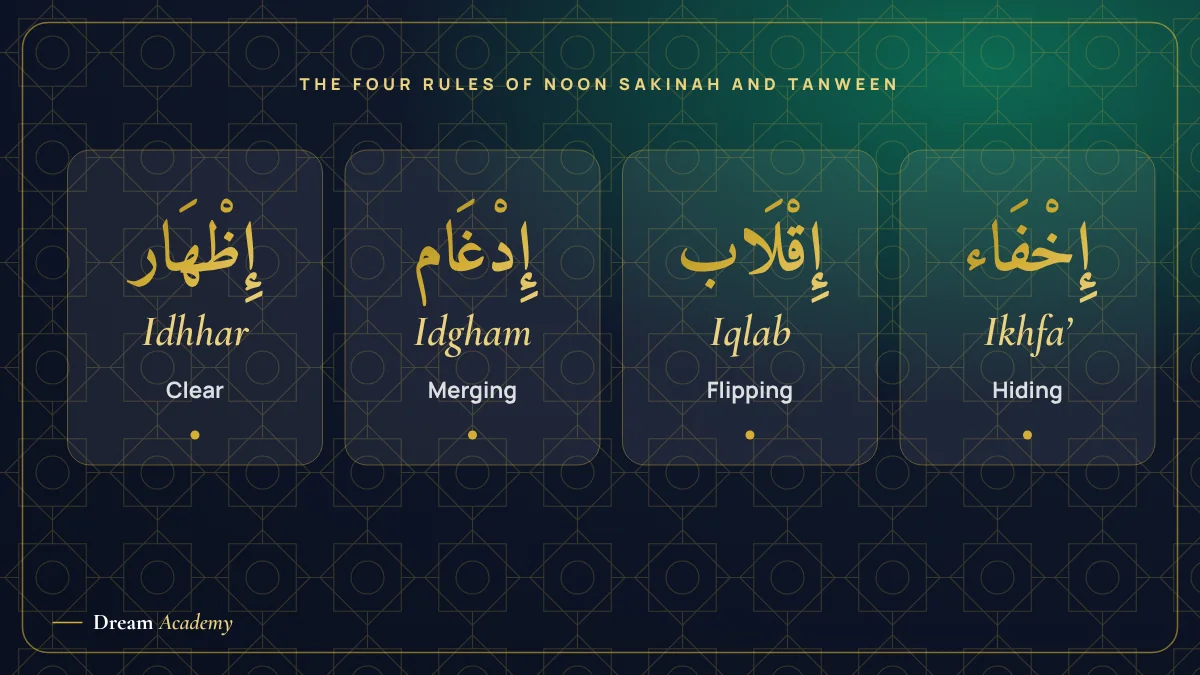
When a noon with sukūn (نْ) or tanween (ـً ـٍ ـٌ) is followed by a letter, one of four rules applies:
| Rule | Meaning | Letters that follow |
|---|---|---|
| Idhhar (إظهار) | Clear pronunciation | ء ه ع ح غ خ |
| Idgham (إدغام) | Merging into the next letter | ي ر م ل و ن (with ghunnah for ي ن م و, without for ل ر) |
| Iqlab (إقلاب) | Flipping the noon into a meem sound | ب |
| Ikhfa’ (إخفاء) | Hiding the noon sound with a nasal tone | The remaining 15 letters |
4. Rules of meem sakinah
When a meem with sukūn (مْ) is followed by a letter, three rules apply:
- Ikhfa’ shafawi: if followed by ب, the meem is softly hidden with a nasal tone.
- Idgham shafawi: if followed by another م, the two meems merge with ghunnah.
- Idhhar shafawi: if followed by any other letter, the meem is pronounced clearly.
5. Ghunnah: the nasal sound
Ghunnah (غنّة) is a nasal sound held for about two counts. It is strongest on a noon or meem with a shadda (نّ مّ), and it also appears in some of the noon sakinah and meem sakinah rules.
6. Qalqalah: the echo
Qalqalah (قلقلة) is a slight echo or bounce when certain letters have a sukūn. The five letters are gathered in the phrase قُطْبُ جَدٍّ:
For example, in the word أَحَدٌ at the end of a verse, the final د is pronounced with a light bounce.
7. Madd: lengthening vowels
Madd means stretching a sound. The simple rule: the three long vowels, alif after a fatḥa, waaw after a ḍamma and yaa after a kasra, are lengthened. The most common types are:
| Type | Length |
|---|---|
| Natural madd (madd ṭabīʿī) | 2 counts |
| Connected madd (madd muttaṣil), a long vowel followed by hamza in the same word | 4 to 5 counts |
| Separated madd (madd munfaṣil), a long vowel at the end of a word followed by hamza at the start of the next | 4 to 5 counts |
| Obligatory madd (madd lāzim), a long vowel followed by a letter with shadda or sukūn | 6 counts |
A “count” is roughly the time of one finger movement, and your teacher will show you the rhythm.
8. The lām in the name of Allah
The lām in the name اللّٰه (Allah) is pronounced heavy after a fatḥa or ḍamma, as in رَسُولُ اللّٰهِ, and light after a kasra, as in بِسْمِ اللّٰهِ.
9. The rā’ (ر): heavy or light
The letter ر is sometimes heavy and sometimes light, depending on its vowel and the letters around it. In general, it is heavy when it carries a fatḥa or ḍamma, and light when it carries a kasra. There are extra cases that your teacher will explain with examples.
10. Waqf and ibtidā’: stopping and starting
Where you stop and restart while reciting matters. Stopping in the wrong place can interrupt the meaning. The Quran includes small signs above the text that guide you, such as the circle that marks the end of a verse, and the letters that indicate whether to stop, continue or choose. When you stop on a word, the final vowel is usually dropped (the word ends with a sukūn).
How to learn Tajweed without feeling overwhelmed
- Start with reading. Make sure you can read connected words smoothly first. See how to learn to read the Quran as an adult beginner.
- Add one rule at a time. Practice it in a few verses before moving on.
- Listen to a skilled reciter, then repeat.
- Recite to a teacher regularly. A teacher hears things you cannot hear yourself.
- Review often. Rules become automatic with repetition.
Join a Tajweed course
Our live Tajweed course walks you through each rule with a teacher, using verses you recite yourself. If you are still learning to read, begin with Quran recitation classes. To compare tutors and academies, use our checklist for choosing an online tutor.
Frequently asked questions
Is Tajweed obligatory?
Scholars generally teach that reciting the Quran correctly, and avoiding mistakes that change the meaning, is required of every Muslim, while learning the detailed rules to a high level is a matter of degree. Ask a qualified teacher or scholar for guidance on your situation.
Can I learn Tajweed from a book or video alone?
They help, but Tajweed is learned by listening and reciting to a teacher who can correct you, because the sounds are passed on by hearing.
How long does it take to learn Tajweed?
It depends on your starting point and practice. Learning the main rules can take a few months of regular lessons, and mastery continues over time.
Do I need to know Arabic to learn Tajweed?
No. You need to be able to read the Quran’s letters and vowels. Understanding the meaning is a separate path.
Want a teacher to hear your recitation? Book a free trial class and begin Tajweed step by step.
Book Your Free Trial