In this article
The Arabic script looks intimidating at first: it runs from right to left, the letters connect, and they change shape. The good news is that the system is very regular. With a clear plan, you can learn to recognize and read the 28 letters in about a week, even if you are starting from zero.
To be honest about expectations: after seven days you will be reading slowly, like a child learning to read. That is a huge milestone, and speed comes with practice.
What you need to know first
- Direction: Arabic is written and read right to left.
- 28 letters: All are consonants. Three of them (ا و ي) also work as long vowels.
- No capital letters.
- Four forms: Most letters change shape depending on where they appear in a word: alone, at the start, in the middle, or at the end.
- Six letters do not connect to the next letter: ا د ذ ر ز و. After one of these, the next letter starts fresh.
- Short vowels are small marks (fatḥa, kasra, ḍamma, sukūn, shadda). Most everyday Arabic leaves them out, and learners start with them to learn pronunciation.
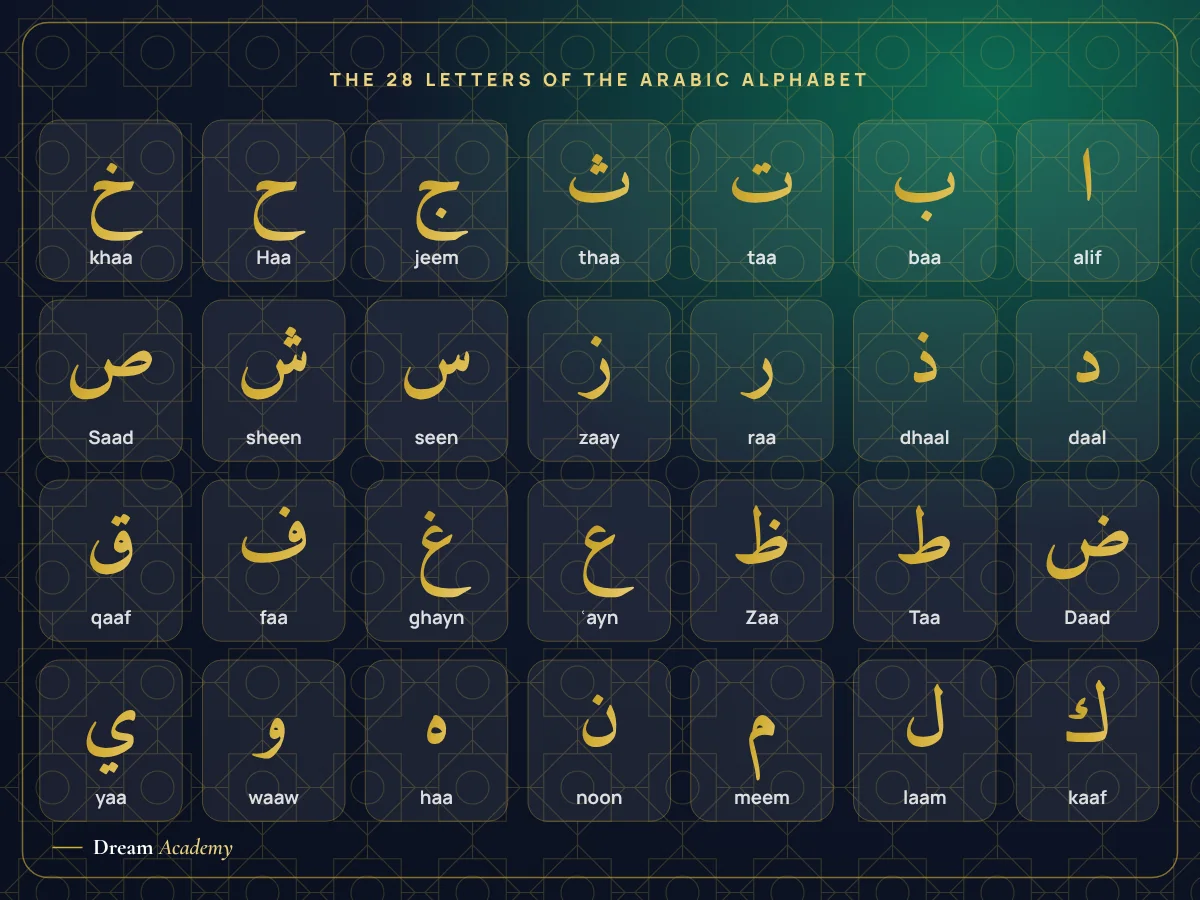
Here is the full alphabet for reference:
Letter shapes at a glance
Many letters share the same base shape and differ only by dots. This is the secret to learning them quickly.
| Letter group | Letters | What to notice |
|---|---|---|
| The “boat” family | ب ت ث | Same shape, with 1 dot below, 2 dots above, and 3 dots above |
| The “hook” family | ج ح خ | Same shape, with 1 dot below, no dot, and 1 dot above |
| The “bowl” pair | د ذ | Same shape, with a dot on ذ |
| The “curve” pair | ر ز | Same shape, with a dot on ز |
Example of how a letter changes shape: ب (alone), بـ (start), ـبـ (middle), ـب (end).
The 7-day plan
Study for 30 to 45 minutes a day. Say each letter out loud, write it by hand several times, and read the example words.
Day 1: ا ب ت ث
Learn alif, baa, taa and thaa. Notice the dot pattern on ب ت ث. Read: باب (bāb, door), بيت (bayt, house).
Day 2: ج ح خ
Learn jeem, Haa and khaa. The ح is a breathy sound from the throat, and خ is like the “ch” in Scottish “loch”. Read: جمل (jamal, camel), خبز (khubz, bread).
Day 3: د ذ ر ز
Learn daal, dhaal, raa and zaay. These four do not connect to the next letter. Read: درس (dars, lesson), زيت (zayt, oil).
Day 4: س ش ص ض
Learn seen, sheen, Saad and Daad. ص and ض are “heavy” letters pronounced with the tongue pulled back. Read: سمك (samak, fish), شمس (shams, sun).
Day 5: ط ظ ع غ
Learn Taa, Zaa, ʿayn and ghayn. ع is a deep throat sound, and غ is like a gargle. Read: طالب (ṭālib, student), عين (ʿayn, eye).
Day 6: ف ق ك ل
Learn faa, qaaf, kaaf and laam. In Egyptian Arabic, ق is often pronounced as a short stop in the throat. Read: قلم (qalam, pen), كتاب (kitāb, book).
Day 7: م ن ه و ي
Learn meem, noon, haa, waaw and yaa. Remember that و and ي can be consonants or long vowels. Read: مدرسة (madrasa, school), نور (nūr, light).
Your first ten words to read
When you finish the seven days, try reading these aloud:
| Arabic | Pronunciation | Meaning |
|---|---|---|
| باب | bāb | door |
| بيت | bayt | house |
| كتاب | kitāb | book |
| قلم | qalam | pen |
| شمس | shams | sun |
| قمر | qamar | moon |
| ماء | māʾ | water |
| سمك | samak | fish |
| مدرسة | madrasa | school |
| صديق | ṣadīq | friend |
Add the short vowels
Once the letters feel familiar, learn the short vowel marks:
| Mark | Name | Sound | Example |
|---|---|---|---|
| ـَ | fatḥa | short “a” | بَ (ba) |
| ـِ | kasra | short “i” | بِ (bi) |
| ـُ | ḍamma | short “u” | بُ (bu) |
| ـْ | sukūn | no vowel | بْ (b) |
| ـّ | shadda | doubled consonant | بّ (bb) |
A simple four-step method for each letter
- See it: look at the isolated letter and its three connected forms.
- Say it: pronounce the sound out loud ten times.
- Write it: copy it by hand five times in each form.
- Use it: read one or two short words that contain it.
Practice tips that make it stick
- Write by hand. Muscle memory helps you remember the shapes.
- Read signs and menus. Sound out any Arabic you see.
- Use flashcards. Put the letter on one side and its name and sound on the other.
- Say the sound while you write.
- Practice with a tutor. A tutor can fix pronunciation of ع ح خ غ ق from the start.
- Review daily. Five minutes a day is better than one long weekly session.
Common beginner mistakes
- Ignoring the dots. One dot changes the letter completely.
- Forgetting the six letters that do not connect.
- Relying only on transliteration. It slows your pronunciation and reading later.
- Trying to memorize every form at once. Learn the isolated shape first, then notice how it joins.
What comes next?
After the alphabet, build reading and listening together. A strong next step is learning common words and survival phrases, such as the ones in our list of 40 essential Egyptian Arabic phrases, and following the beginner roadmap. If your goal is reading the Quran, the alphabet is the first step toward learning the Quran as an adult beginner, and our Quran recitation course guides you from there.
Frequently asked questions
Can I really learn the Arabic alphabet in a week?
You can learn to recognize and sound out all 28 letters in a week with daily practice. Reading smoothly takes more time and repetition.
Do I need to learn Arabic handwriting?
It helps a lot. Writing the letters by hand fixes the shapes in your memory, even if you mostly type later.
Why do some letters look different in the middle of a word?
Arabic is written in a connected script, so letters adjust their shape to join the letters next to them.
Should I learn the alphabet before speaking Egyptian Arabic?
You can speak first, but learning the alphabet in your first weeks improves your pronunciation and lets you read.
Want a tutor to check your pronunciation? Book a free trial class and start reading Arabic with confidence.
Book Your Free Trial